First drafts from precedent and matter facts
A starting document assembled from your own precedent and the facts of the matter, so the practitioner edits and exercises judgement instead of retyping. Your precedents stay the source of truth.
AI training for law firms
We train practitioners and support staff to use AI on the drafting, summarising and correspondence that fills the week — with the verification discipline built in from day one. Three months on your own matters, delivered by Claude Certified Associates. Unbillable writing time turns back into billable work.
Trusted by over 14,000 Australian businesses. Australian-owned since 2008, rated 4.8 from 229 Google reviews, and delivered by Claude Certified Associates.








Every one of these is a drafting or comprehension task with a practitioner's review at the end. None of them is legal judgement, and the program is precise about that boundary.
A starting document assembled from your own precedent and the facts of the matter, so the practitioner edits and exercises judgement instead of retyping. Your precedents stay the source of truth.
A dated sequence of events pulled from correspondence and documents with sources noted, as a working draft for the practitioner to verify. The reading still happens — faster, and in the right order.
Contracts, reports and correspondence chains reduced to the terms, obligations and dates that matter, so a matter can be picked up quickly without missing a clause.
Plain-English updates drafted from the file — what has happened, what it means, what happens next — so clients stay informed without a partner losing an hour.
Rough notes from a conference turned into a structured file note on the day, for the practitioner to check and sign, rather than reconstructed a week later.
A judgment, a legislative change or a clause turned into something a commercial client can decide from, with the practitioner confirming accuracy before it goes.
Your firm's own drafting standards captured as shared resources, so a junior's first draft starts from how your practice writes rather than from a blank page.
Three stages, each ending in something the practice does differently on the next matter.
Month one establishes the discipline — never cite what you have not opened — and then gets each person drafting, summarising and note-taking with AI on live matters. In this profession the discipline has to be habitual before the speed is worth having.
Month two turns those into reusable resources the practice runs on: the client update format, the file note structure, the chronology method, the summarising prompts for your areas of work. One practitioner's approach becomes the firm's, which is what makes juniors useful faster.
By month three your team is building simple agents that gather and prepare — turning a document bundle into a verified-source chronology, or a matter file into a client update draft — with a practitioner reviewing and signing everything that leaves the office.
I’ve just finished the Ad On AI training course, and it’s made a big difference in how I work. The techniques covered have cut down a lot of the repetitive, manual work in my day. That’s given me more time to focus on what really moves the needle - talking with clients and thinking through the bigger picture of how to grow their business. It’s an invaluable program, and one that’s helping me serve clients better.
I joined this AI course recently and I’ve been really happy with it so far. The content is good and easy to follow, and whenever I’ve had a question the support team has sorted me out quickly. It’s already helping me with my business. Worth the money, would recommend to anyone thinking about it.
Completing the Ad On AI training saved me countless hours on manual tasks. I’m now able to spend my day on meaningful, strategic work.
Rated 4.8 from 229 Google reviews.
We start with the failure the profession has already read about. General-purpose AI tools invent case citations that look entirely real — correct format, plausible names, confident tone — and practitioners in several jurisdictions have been sanctioned for filing them. It is a predictable property of how the tools work, not a rare glitch, and training that glosses over it is dangerous. We teach it as a core module: never cite what you have not opened, treat every authority as unverified until checked in a real database, and understand why the output sounds certain either way.
On confidentiality: client information is subject to privilege and to your conduct rules. The program covers which tools carry terms that make business use defensible, what must never be pasted into a consumer tier, and how to build workflows where privileged material stays inside systems you control. Your firm finishes with a written policy your principal signs off before anything runs on live matters.
24 modules, all self-paced, so it fits around legal work rather than pulling anyone off the job for a day. It runs in three stages: getting fluent with the tools, automating the tasks that repeat, then building AI agents that handle a slice of a job end to end.
What we teach is tool-agnostic. Your team learns the thinking, then applies it in ChatGPT, Copilot, Gemini or Claude — so the skills survive whichever tool you standardise on next year.
For a firm, month one is the verification discipline and file notes, and the agent most practices build first turns a document bundle into a sourced chronology. 24 interactive modules, all at your own pace — full of worked examples, videos and step-by-step instructions, and they keep growing as the tools do.
Topic 1 Foundations get fluent
Advanced prompt engineering and context management. Claude Projects that hold everything about your business, so nobody re-explains it every time. Getting AI to work across your documents, images and screenshots. Building your first AI-powered workflow, end to end.
Topic 2 Automating your tasks get your time back
Teaching AI your job. Custom Claude skills built around how your team actually works, plus a meta skill that writes the next ones. Claude Cowork and Claude in Chrome browser automations across the tools you already use, scheduled to run without anyone starting them.
Topic 3 Agentic AI go autonomous
Handing whole jobs over. Building autonomous AI agents that carry out complete processes on their own — deciding what to do next, working across your tools, running start to finish without anyone watching — then an orchestrator agent that directs them all as one system.
Delivered by Claude Certified Associates — not generalists who added an AI workshop last year. Ad On Group has been running as an Australian business since 2008.
Every program includes it. This is the difference between a team that had AI training once and a team that keeps getting better at it while the tools keep changing.
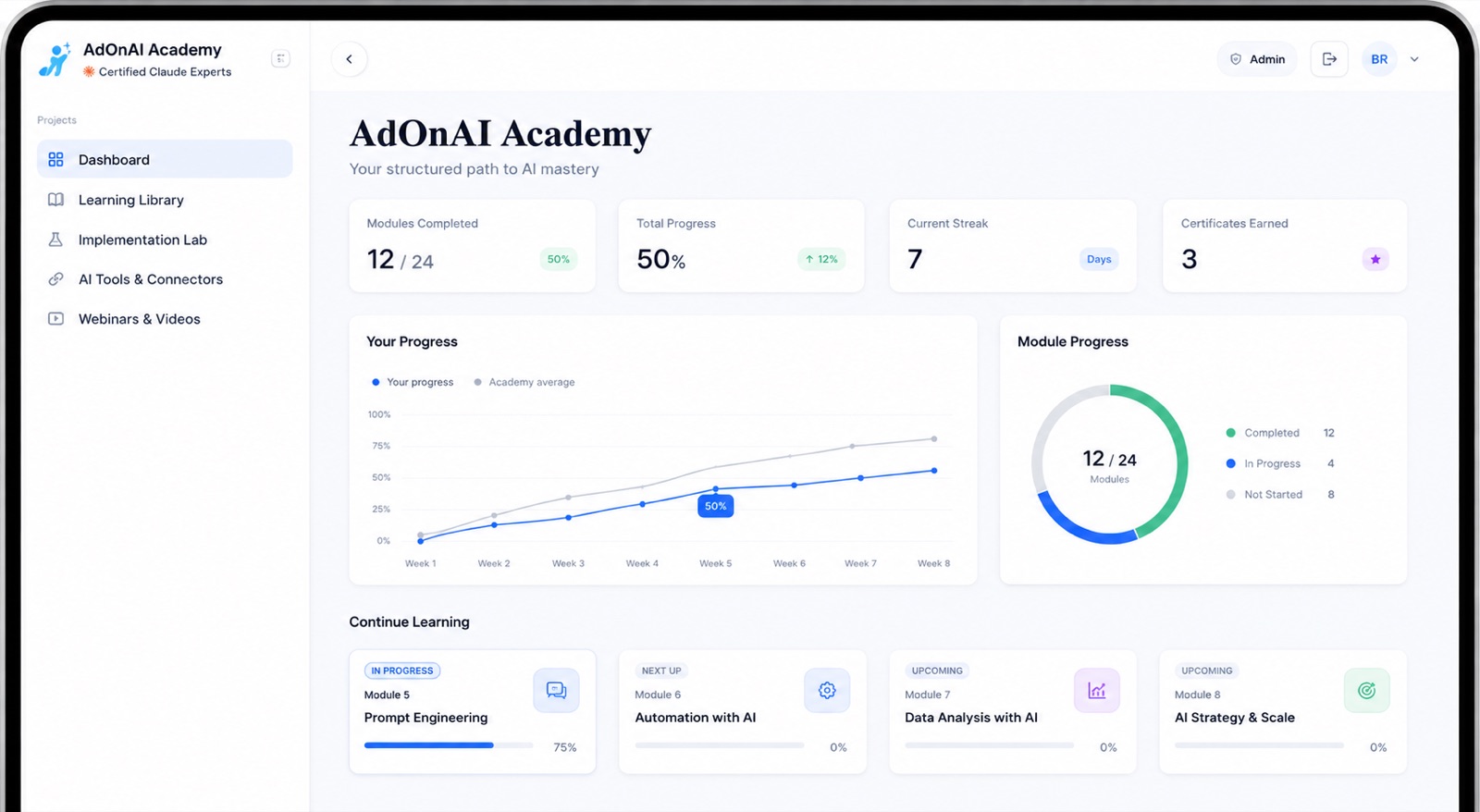
24 interactive modules, self-paced, yours for life. The modules keep growing as AI does, so what your team learned last year does not quietly go out of date.

An hour each, one to one with a Claude Certified Associate, spent on your team's actual work rather than a curriculum. This is where the difficult, specific problems get solved.

Fresh sessions and podcasts on real business applications, released weekly — because the tools change monthly and a course recorded last year cannot keep up on its own.
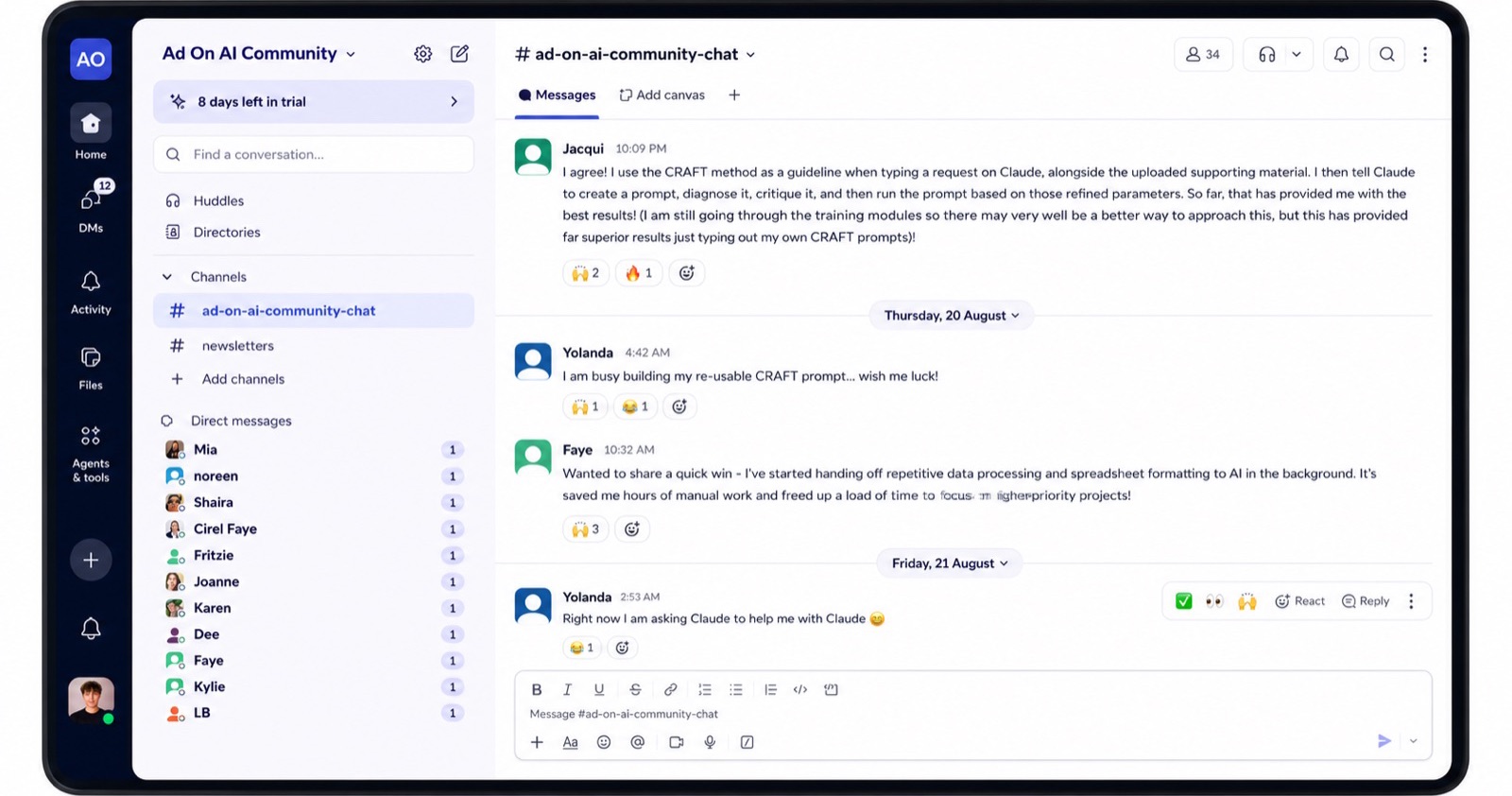
A closed space to ask, share and show what is working, alongside staff from other Australian businesses using AI daily. Most people find the peer answers as useful as ours.
Get in touch and we'll show you how AI fits your practice — the work worth compressing first, what three months looks like for a firm your size, and what it costs. Or take the AI audit first: six questions, about a minute.
AI in legal practice: drafting safely, and the citation trap — 2 March 2027, 12:30pm AEST. Free, online, 45 minutes, open to anyone. Starting with the failure the profession has already read about, then the drafting and summarising work where these tools genuinely earn their place.
We're on the Gold Coast, we work across South East Queensland and Northern NSW, and we have an office in Adelaide. The program runs online and self-paced, so your team gets the same thing wherever they are.
Brisbane is where most South East Queensland firms are concentrated, but the practices feeling the drafting load hardest are usually the smaller suburban ones — Ipswich, Logan, the Gold Coast — where there is no paralegal bench to absorb it and the principal is doing the writing.
A workshop teaches awareness; three months changes behaviour — and in this profession it also builds the verification habit, which one day cannot. Practitioners leave a workshop aware that AI fabricates citations and still have no working discipline for catching it. Our program runs across three months on your own matters, and the ongoing support keeps it current as the tools change.
Untrained use is risky, and that risk is already inside your firm — staff are using these tools whether or not there's a policy. Trained use, with verification built in and the boundaries understood, is considerably safer than the unsupervised use happening now. Closing that gap is the entire argument for the program.
It's quoted per team size, and the three months is a fixed cost rather than an open-ended engagement, so you know the total before you start. Tell us how many practitioners and support staff you'd send and we'll give you the number, along with the work we'd expect to compress first.
Research belongs in a proper legal database, and we train people to keep it there — general-purpose models have no authoritative access to Australian case law and will fabricate confidently. AI earns its place once you have the material: summarising, structuring, drafting and explaining.
Often more. Legal secretaries, paralegals and practice managers do a large share of the drafting, formatting and correspondence, and that's the work that compresses most. Many firms start there and bring practitioners in after.
It converts unbillable drafting time into billable matter time, which is where most firms are constrained — the writing around the work was never the part clients were paying for. Firms on fixed-fee or capped work see it land straight as margin.
Writing it is part of the program rather than a prerequisite. Teams draft their own during the course, informed by how the tools actually behave rather than by guesswork, and the principal signs it off before it applies to live matters.
Take the audit and you'll know in a minute where your practice stands and what to compress first. Or get in touch and we'll walk through the first month — starting with the verification discipline, because in this profession that's the part that has to be right first.