AI training for construction and engineering firms
We train site and office staff to turn rough notes into finished documents fast — variations, RFIs, quotes, safety paperwork. Three months, built around voice notes from a ute rather than a desk, delivered by Claude Certified Associates. The paperwork stops deciding your margin.
Trusted by over 14,000 Australian businesses.
Australian-owned since 2008, rated 4.8 from
229 Google reviews, and delivered by Claude Certified Associates.
We already work in this sector
Ad On Group works with trades and engineering businesses across Australia, including Bison Electrical, AIRLEC Adelaide Electrical and Calibre Engineering. Ask us and we'll put you in touch with businesses we work with.
The admin that decides whether a job makes money
Variations done on site and never written up, which means never charged.
Quotes and tender responses going out late because someone had to write them after hours.
RFIs sitting unanswered because drafting one properly takes longer than it should.
SWMS and toolbox talks copied from the last job and not really reviewed.
Progress reports assembled from a site diary at the end of the month.
A 200-page spec someone has to search to answer one question about a clause.
The person writing the variation being the same person running the job.
What a construction business uses AI for
Almost all of this starts from a voice note or three lines typed with one thumb. That's the realistic input in this industry, and it's what the program is built around.
Variations, written up the same day
A voice note from site turned into a variation request with scope, reason and cost implication in your standard format — while the detail is fresh and before the client forgets they asked for it. This one usually pays for the program on its own.
Quotes and tender responses
First drafts of the written sections from your scope notes and previous submissions, so the estimator spends the time on numbers and risk instead of prose.
Finding the clause in the spec
A long specification or contract queried in plain language to find the relevant provision and what it requires — minutes instead of an afternoon, with the reference to check.
Safety documentation
SWMS and toolbox talk content drafted for the specific task and site conditions rather than recycled unchanged, then reviewed by the person accountable for it.
RFIs and site correspondence
Clear, specific RFIs drafted from a site observation, and follow-up correspondence that keeps the record straight without anyone sitting down to compose it.
Progress reports and client updates
Site diary entries and photos turned into the monthly client report in a consistent format, without a project manager losing a day to it.
Handover and defects documentation
O&M information, defect lists and close-out correspondence assembled from what's already recorded, so the last ten per cent of the job stops dragging.
Where your business is after three months
Three stages, each ending in something that shows up on the next job.
1
Nothing goes unwritten
By the end of month one, supervisors and project managers are turning voice notes into variations, RFIs and site correspondence on the day. This is where the revenue you were already owed starts getting captured.
2
One format across every job
Month two turns those into shared templates the business runs on — the variation, the RFI, the progress report, the toolbox talk. Your best documenter's format becomes the standard, which is what makes the paperwork defensible when a job goes to dispute.
3
Agents handling the assembly
By month three your team is building simple agents that gather and draft — turning a month of site diary entries into the client report, or a set of photos and notes into a defects list — with a person reviewing before anything goes out.
What people say after the program
★★★★★
I’ve just finished the Ad On AI training course, and it’s made a big difference in how I work. The techniques covered have cut down a lot of the repetitive, manual work in my day. That’s given me more time to focus on what really moves the needle - talking with clients and thinking through the bigger picture of how to grow their business. It’s an invaluable program, and one that’s helping me serve clients better.
Amy Fennell
★★★★★
I joined this AI course recently and I’ve been really happy with it so far. The content is good and easy to follow, and whenever I’ve had a question the support team has sorted me out quickly. It’s already helping me with my business. Worth the money, would recommend to anyone thinking about it.
Warren Johnson
★★★★★
Completing the Ad On AI training saved me countless hours on manual tasks. I’m now able to spend my day on meaningful, strategic work.
Aria
Rated 4.8 from 229 Google reviews.
Numbers, specs, and people who aren't at a computer
This industry runs on measurements, quantities, standards and prices, and a plausible-looking wrong number is worse than no number. We train the boundary hard: AI drafts the words around the numbers, a person owns the numbers themselves, and anything referencing a standard or a contract clause is checked against the source. It's a drafting assistant, and the discipline that keeps it one is part of the course.
The second point shapes the whole program. Your people are on site, not at a desk, so every workflow we teach starts from a voice note or a photo on a phone. A process that requires sitting down at a laptop does not survive a real week, so we don't teach one.
How the training works
24 modules, all self-paced, so it fits around
construction work rather than pulling anyone off the job for a day. It runs in three
stages: getting fluent with the tools, automating the tasks that repeat, then building
AI agents that handle a slice of a job end to end.
What we teach is tool-agnostic. Your team learns the thinking, then applies it in
ChatGPT, Copilot, Gemini or Claude — so the skills survive whichever tool you
standardise on next year.
What your team actually learns
For a builder, month one is variations from voice notes, and the agent most teams build first turns a month of site diary entries into the client progress report.
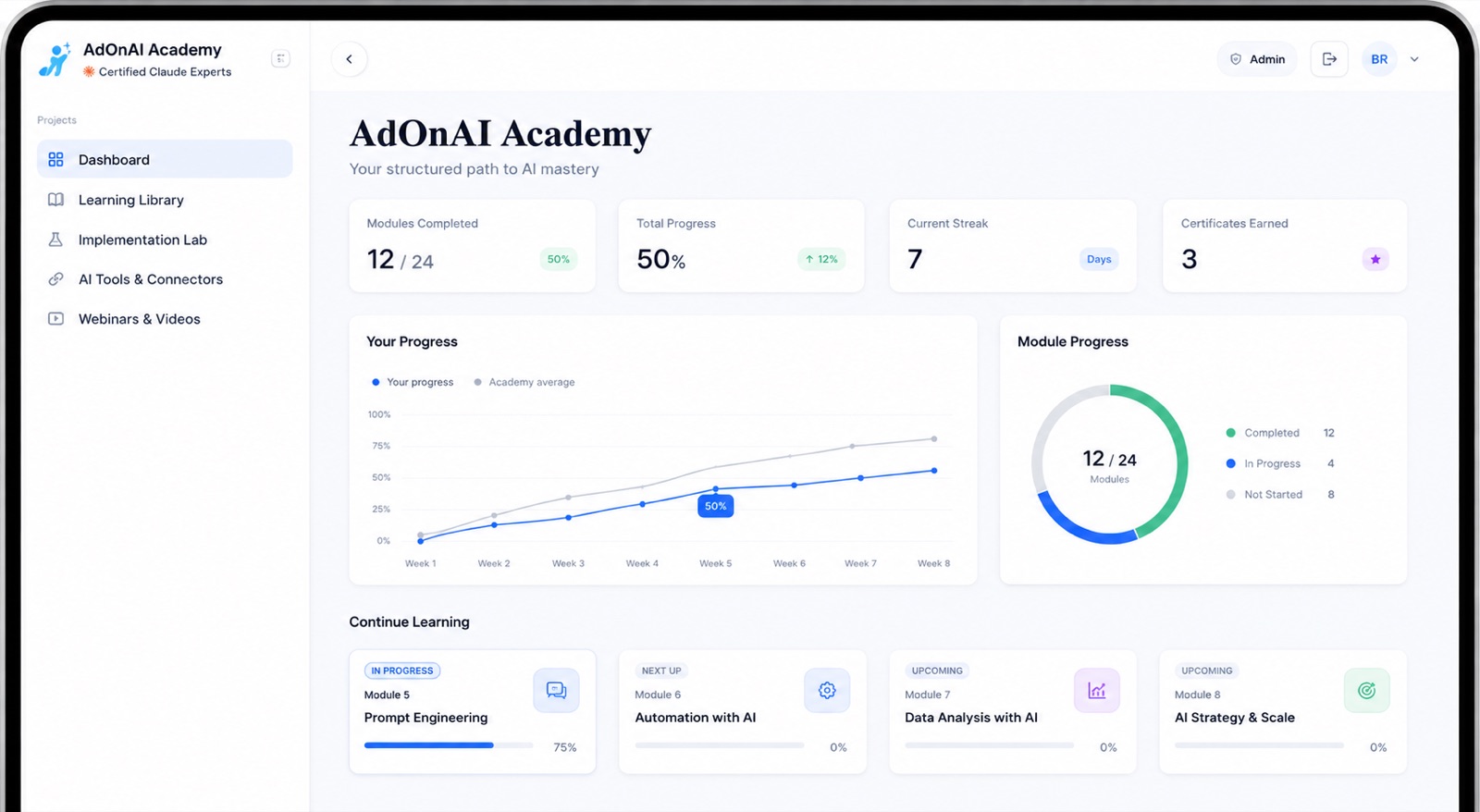
24 interactive modules, all at your own pace — full of worked examples, videos and step-by-step
instructions, and they keep growing as the tools do.
Topic 1 Foundations get fluent
Advanced prompt engineering and context management. Claude Projects that hold everything about your business, so nobody re-explains it every time. Getting AI to work across your documents, images and screenshots. Building your first AI-powered workflow, end to end.
Advanced prompt engineering
Context management
Claude Projects for business context
Working with documents, images and screenshots
Building an AI-powered workflow end to end
Topic 2 Automating your tasks get your time back
Teaching AI your job. Custom Claude skills built around how your team actually works, plus a meta skill that writes the next ones. Claude Cowork and Claude in Chrome browser automations across the tools you already use, scheduled to run without anyone starting them.
Custom Claude skills
Meta skills that build further skills
Claude Cowork automations
Claude in Chrome browser automation
Scheduling automations to run unattended
Topic 3 Agentic AI go autonomous
Handing whole jobs over. Building autonomous AI agents that carry out complete processes on their own — deciding what to do next, working across your tools, running start to finish without anyone watching — then an orchestrator agent that directs them all as one system.
Delivered by Claude Certified Associates — not generalists who added an AI
workshop last year. Ad On Group has been running as an Australian business
since 2008.
Every program includes it. This is the
difference between a team that had AI training once and a team that keeps getting
better at it while the tools keep changing.
Your own learning platform
24 interactive modules, self-paced, yours for life. The modules keep growing as AI does, so what your team learned last year does not quietly go out of date.
Two private sessions every month
An hour each, one to one with a Claude Certified Associate, spent on your team's actual work rather than a curriculum. This is where the difficult, specific problems get solved.
New masterclasses every week
Fresh sessions and podcasts on real business applications, released weekly — because the tools change monthly and a course recorded last year cannot keep up on its own.
A community of teams doing the same thing
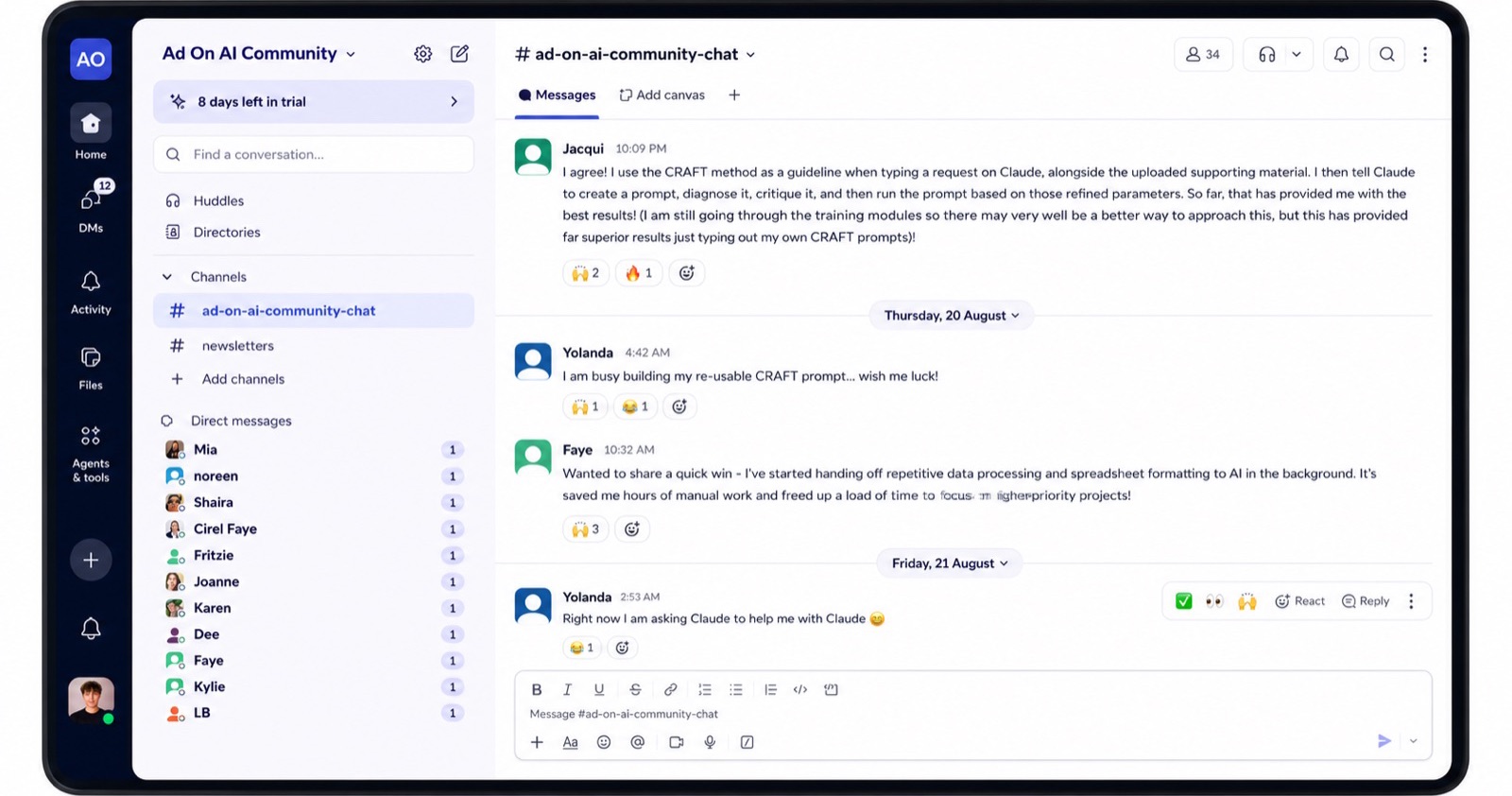
A closed space to ask, share and show what is working, alongside staff from other Australian businesses using AI daily. Most people find the peer answers as useful as ours.
Get in touch and we'll show you how AI fits the way your jobs run — what to capture first, what three months looks like for a team your size, and what it costs. Or take the AI audit first: six questions, about a minute.
AI on site: turning voice notes into variations and RFIs — 2 February 2027, 12:30pm AEST. Free,
online, 45 minutes, open to anyone. For people who are not at a desk. Everything in this session starts from a voice note or three lines typed with one thumb.
We're on the Gold Coast, we work across South East Queensland and Northern NSW, and
we have an office in Adelaide. The program runs online and self-paced, so your team
gets the same thing wherever they are.
South East Queensland is in the middle of a long run of infrastructure and residential work ahead of 2032, and the documentation per job has grown with it. Builders and subcontractors across Brisbane, Ipswich, Logan and the Gold Coast are running more jobs with the same office staff, which is exactly when variations stop getting written up.
A workshop teaches awareness; three months changes behaviour. Site staff sit through a workshop and are back to writing variations up on Sunday within a fortnight, because nobody built the habit on live jobs. Our program runs across three months on your own work, and the ongoing support keeps it current as the tools move.
Will site staff actually use it?
It starts from how they already work — voice notes and phones rather than desktop tools — which is what makes the difference. Supervisors and project managers pick it up fastest, and that's where the paperwork sits anyway.
What does it cost?
It's quoted per team size, and the three months is a fixed cost rather than an open-ended engagement, so you know the total before you start. Tell us who you'd send and we'll give you the number, along with what we'd expect to compress first — usually variations.
Can it price a job?
Pricing stays with your estimator, and we train people to keep it there. AI drafts the written parts of a quote or tender around numbers your estimator owns, which is where the time actually goes.
Is it safe to put contract documents into it?
With the right tool tier and terms, and that setup is part of the training. Head contracts and commercially sensitive tender material need the business terms rather than a consumer account, and we cover exactly which is which.
We're a subcontractor with 20 staff, not a tier-one builder. Is this for us?
Smaller businesses usually feel it more, because the person writing the variation is also the person running the job. The unwritten variation problem is a subcontractor problem far more than a head contractor one.
What about drawings and models?
The program covers the documentation layer — the writing, reading and summarising around the work, which is where the unbilled hours are. Design and modelling tools are a separate purchase and we'll tell you so rather than sell you something we don't teach.
Take the audit and you'll know in a minute where your business stands and what to capture first. Or get in touch and we'll walk through the first month — if unwritten variations are costing you, that's where we start.