We train accounting and bookkeeping staff to use AI on the work that eats the week — the chasing, the drafting, the explaining. Three months, built around your practice's real files, delivered by Claude Certified Associates. Your team finishes doing the same work in a fraction of the time.
Trusted by over 14,000 Australian businesses.
Australian-owned since 2008, rated 4.8 from
229 Google reviews, and delivered by Claude Certified Associates.
Where the week actually goes
Chasing clients for records that were requested three times already, in three separately written emails.
Re-explaining the same tax position to a different client, in plain English, from scratch.
Reading back through a year of correspondence before a meeting to remember what was agreed.
Turning a messy bank feed or a shoebox of receipts into something you can reconcile.
Writing variance commentary that says more than “up 12%”.
Capacity that vanishes from July, and again at every BAS deadline.
Junior staff spending their first two years on work that is mostly retyping.
What an accounting team uses AI for
These are the tasks practices bring us in the first fortnight, because they repeat, they are made of text, and they are worth hours a week per person. Every one is taught on your own files, not on a demo dataset.
Chasing records, without writing the email
Outstanding-items follow-ups drafted from your checklist, escalating in tone across the sequence, in your firm's voice rather than a template clients learn to ignore. Practices tell us this alone clears a morning a week in the lead-up to lodgement.
Plain-English client explanations
A Div 7A position, a trust distribution, why the refund is smaller this year — written for a client who doesn't read jargon, from your file notes, ready for you to check and send. The explanation your partner would have written, in the time it takes to read it.
Getting up to speed before a meeting
A year of correspondence and file notes reduced to what was agreed, what's outstanding, and what they asked last time. Ten minutes of reading instead of forty, and nobody walks in cold.
Management accounts commentary
Draft variance narrative straight from the numbers you've already produced — what moved, by how much, and the question you'd have asked anyway. Your judgement, already typed up.
Turning ATO guidance into client notes
A rate change or a new ruling converted into a short, client-ready update per entity type, so your clients hear it from you first instead of one generic newsletter nobody opens.
Cleaning up the inputs
Extracting and structuring data from invoices, statements and PDFs so reconciliation starts from something usable — with the verification step built into the workflow, because a misread digit is expensive here.
Bringing juniors up faster
The drafting your graduates learn on gets a first pass, so their time goes into checking, questioning and understanding the position rather than retyping it. The training compounds into how quickly your bench develops.
Where your practice is after three months
The program runs in three stages, and each one ends with something your team is doing differently on Monday. This is the sequence, not a syllabus.
1
Everyone fluent on their own work
By the end of month one, each person has three or four recurring tasks they now do with AI by default — their tasks, from their week, not exercises. This is the point where the time saving becomes visible on a timesheet.
2
The repeating work, automated
Month two turns those into reusable prompt packs the whole practice shares: the chase sequence, the client explainer, the commentary draft, the file summary. One person's good workflow becomes everybody's, which is where a practice pulls ahead of an individual who is good with ChatGPT.
3
Agents handling a slice end to end
By month three your team is building simple AI agents — an outstanding-records chaser that drafts, tracks and escalates on its own, or a workflow that turns a client's document dump into a structured, queried summary. No coding, and it is the part nobody expects to reach.
What people say after the program
★★★★★
I’ve just finished the Ad On AI training course, and it’s made a big difference in how I work. The techniques covered have cut down a lot of the repetitive, manual work in my day. That’s given me more time to focus on what really moves the needle - talking with clients and thinking through the bigger picture of how to grow their business. It’s an invaluable program, and one that’s helping me serve clients better.
Amy Fennell
★★★★★
I joined this AI course recently and I’ve been really happy with it so far. The content is good and easy to follow, and whenever I’ve had a question the support team has sorted me out quickly. It’s already helping me with my business. Worth the money, would recommend to anyone thinking about it.
Warren Johnson
★★★★★
Completing the Ad On AI training saved me countless hours on manual tasks. I’m now able to spend my day on meaningful, strategic work.
Aria
Rated 4.8 from 229 Google reviews.
Client data: the part most providers skip
You hold other people's financial information under a professional obligation, and most AI training simply doesn't address it. We build a substantial part of the program around it: which tools carry the contractual terms that make business use defensible, which consumer tiers train on what you paste into them, what has to be de-identified, and what should never leave your systems at all.
Your practice finishes with a written AI usage policy your team actually follows — drafted during the program, informed by how the tools behave rather than by guesswork. That matters more than it sounds: your staff are already using these tools. The choice is whether that happens inside a policy you wrote or outside one you didn't.
How the training works
24 modules, all self-paced, so it fits around
accounting work rather than pulling anyone off the job for a day. It runs in three
stages: getting fluent with the tools, automating the tasks that repeat, then building
AI agents that handle a slice of a job end to end.
What we teach is tool-agnostic. Your team learns the thinking, then applies it in
ChatGPT, Copilot, Gemini or Claude — so the skills survive whichever tool you
standardise on next year.
What your team actually learns
For a practice, month one usually lands on the chase sequence and client explanations, and the agent people build first is almost always the outstanding-records chaser.
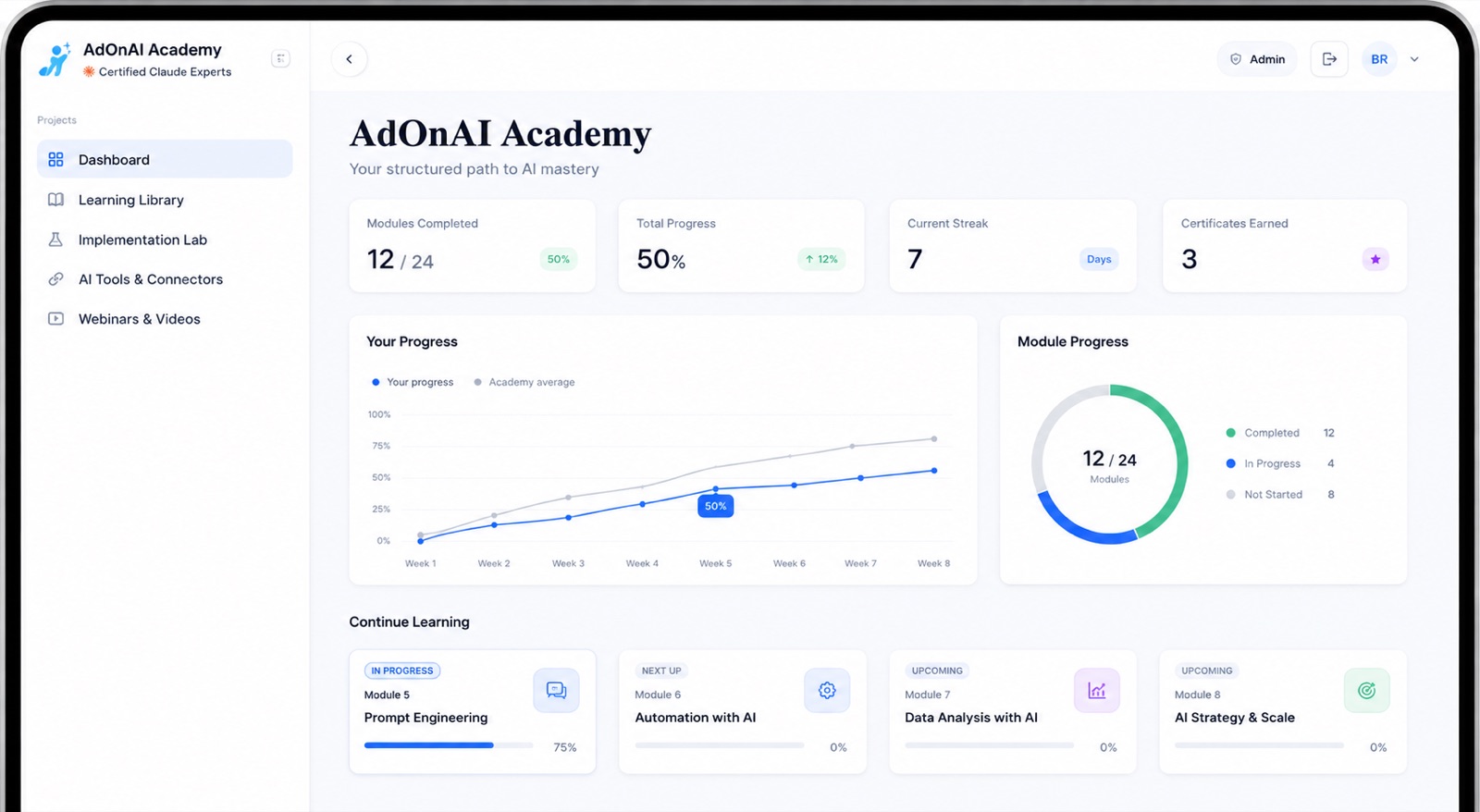
24 interactive modules, all at your own pace — full of worked examples, videos and step-by-step
instructions, and they keep growing as the tools do.
Topic 1 Foundations get fluent
Advanced prompt engineering and context management. Claude Projects that hold everything about your business, so nobody re-explains it every time. Getting AI to work across your documents, images and screenshots. Building your first AI-powered workflow, end to end.
Advanced prompt engineering
Context management
Claude Projects for business context
Working with documents, images and screenshots
Building an AI-powered workflow end to end
Topic 2 Automating your tasks get your time back
Teaching AI your job. Custom Claude skills built around how your team actually works, plus a meta skill that writes the next ones. Claude Cowork and Claude in Chrome browser automations across the tools you already use, scheduled to run without anyone starting them.
Custom Claude skills
Meta skills that build further skills
Claude Cowork automations
Claude in Chrome browser automation
Scheduling automations to run unattended
Topic 3 Agentic AI go autonomous
Handing whole jobs over. Building autonomous AI agents that carry out complete processes on their own — deciding what to do next, working across your tools, running start to finish without anyone watching — then an orchestrator agent that directs them all as one system.
Delivered by Claude Certified Associates — not generalists who added an AI
workshop last year. Ad On Group has been running as an Australian business
since 2008.
Every program includes it. This is the
difference between a team that had AI training once and a team that keeps getting
better at it while the tools keep changing.
Your own learning platform
24 interactive modules, self-paced, yours for life. The modules keep growing as AI does, so what your team learned last year does not quietly go out of date.
Two private sessions every month
An hour each, one to one with a Claude Certified Associate, spent on your team's actual work rather than a curriculum. This is where the difficult, specific problems get solved.
New masterclasses every week
Fresh sessions and podcasts on real business applications, released weekly — because the tools change monthly and a course recorded last year cannot keep up on its own.
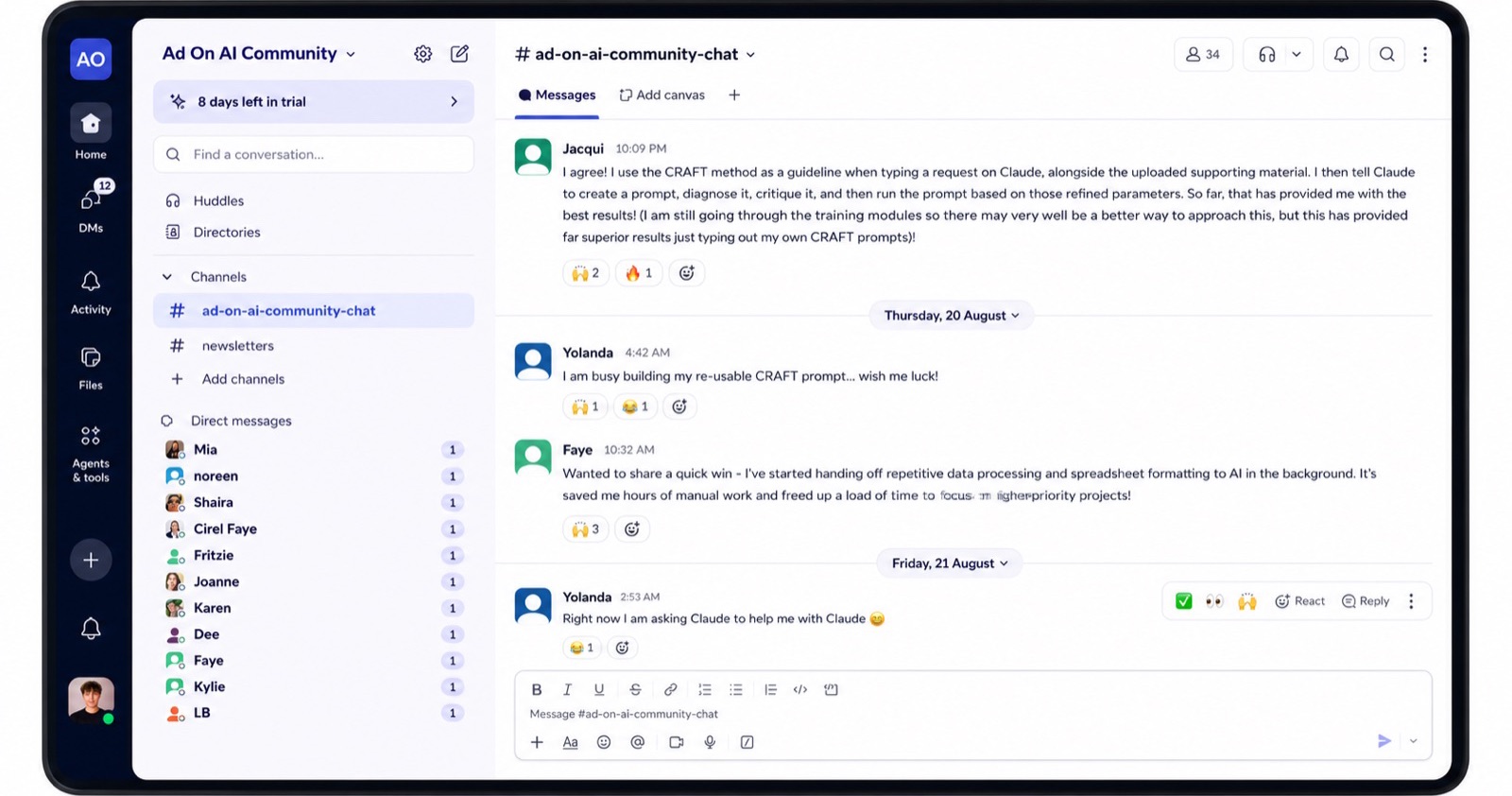
A community of teams doing the same thing
A closed space to ask, share and show what is working, alongside staff from other Australian businesses using AI daily. Most people find the peer answers as useful as ours.
Get in touch and we'll show you how AI fits your practice — the tasks worth starting with, what three months looks like for a team your size, and what it costs. Or take the AI audit first: six questions, about a minute.
We're on the Gold Coast, we work across South East Queensland and Northern NSW, and
we have an office in Adelaide. The program runs online and self-paced, so your team
gets the same thing wherever they are.
South East Queensland's growth corridors — Ipswich and Logan in particular — have added small businesses faster than they have added accountants, which is where the capacity squeeze bites hardest. Brisbane and Gold Coast practices more often come to us about turnaround time than headcount.
A workshop teaches awareness; three months changes behaviour. People leave a workshop enthusiastic and are back to their old habits within a fortnight, because nobody built a new habit on real work in one day. Our program runs across three months on your practice's own files, so by the end it is simply how your team works — and ongoing support keeps it current after that, which a workshop by definition cannot.
Will this work for staff who aren't technical?
That's exactly who it's built for. No coding, no setup, no prompt-engineering theory. If someone can write an email to a client, they can do this — the program starts from that assumption rather than treating it as a limitation.
What does it cost?
It's quoted per team size, and the three months is a fixed cost rather than an open-ended engagement — you know the total before you start. Tell us how many people you'd send and we'll give you the number on the call, along with the tasks we'd expect to compress first so you can judge it against the hours.
Does AI do the accounting itself?
It does the writing and reading around the work, which is most of the week. The judgement, the review and the sign-off stay with the accountant, which is what your professional obligations require and what we design the workflows around. That boundary is deliberate, and it's why the training holds up under a QA review.
We're a five-person practice. Is this only for big firms?
Small practices usually get more out of it, because there's nobody to delegate the drafting to. The program is priced and paced for SME teams, and it's the same three months whether you send two people or twenty.
When should we start, given tax season?
Before it. Practices that come through in autumn go into the crunch with the follow-up and drafting workflows already built, which is when the saving is worth the most. If you're reading this mid-season, the audit takes a minute and the conversation can wait until you surface.
Do we need to buy new software?
Not to start. Most practices already have a paid ChatGPT, Copilot or Claude seat somewhere in the business, and the training is tool-agnostic in any case — your team learns the thinking, then applies it in whatever your practice standardises on.
Take the audit and you'll know in a minute where your practice stands and which three tasks to start with. Or book the call and we'll walk you through what the first month would look like for a team your size.